
This section covers various aspects of models and modeling. What form do they take and when to use them and what to expect from them. This will assist when it comes time to propose a model for wicked problems.
Why model
In the previous section many models were used to describe the natural sciences. The models were used to describe, compare, categorize or illustrate different aspects of the natural sciences. Is it advantageous to use model(s) for wicked problems, what use is any model in this circumstance when the human element is introduced?
Or the question could be reframed, can models be ignored when discussing wicked problems. Guess you have a sneaking idea what the answer will be!!
Humans think using mental models. These are representations of reality that make the world comprehensible. They allow us to see patterns, predict how things will unfold, and make sense of the circumstances we encounter.
. . . Mental models bring order. They let us focus on essential things and ignore others—
We use mental models all the time, even if we are not aware of them. But there are moments when we are acutely conscious of how we size up a situation, and can deliberately maintain or change our perspective. (Cukier, Mayer-Schönberger, & Véricourt, 2021, p. 3)
When the general community discuss, debate or argue about politics, social issues or current affairs they typically have a mental model in mind of how things should be, even if we are not aware of them. This differs from the formal models that are created to convey ideas and thoughts which are presented to others as in the previous section. Formal models may have general agreement and are published and taught to students. For example there are many formal mathematical or graphical models used in economics which have been debated and discussed that convey theories of how economics work in society.

Figure 1: Graphical representation of an economic supply and demand curves. (Zdziarski, 2006) This models the behaviour of suppliers producing goods at some particular price driving the demand of customers. Behind such a model are other assumptions regarding rational actors making rational decisions based on available information.
Models may also contain many underlying assumptions, for example, in neoclassical economics the concept of a rational actor. Only later has the concept of rational actor been challenged which brings in underlying models related to what is rational behaviour from fields such as the cognitive sciences or philosophy.
The aim is to bring awareness to basic assumption people make when discussing social issues or proposing solutions. Models can assist in identifying and articulating the relationships between areas of interest dealing with social issues. It is a tool like any other, only as good as its proponent.
For example, are basic assumptions as the following valid:
- The education of the public to generate coherence in accepting a scientific approach to solving social problems – educate the public in STEM subjects under the guise of the information deficit model
- Innovation’s role in overcoming or alleviating social issue – many governments have policies related to innovation and its importance to advance society.
- We should be rational about issues – if we are not rational then we are subjective to superstition, myths, or poorly formed opinions.
What is a model
A scientific model is a physical and/or mathematical and/or conceptual representation of a system of ideas, events or processes. (Victoria State Government, n.d.) They are typically used to assist in visualizing an object or system; be predictive in nature; describe a hypothetical or abstract phenomena; which leads to an understanding of the natural world. Models are approximations of the phenomena they represent and are not exact or complete representations, therefore models have limitations since they do not integrate all the details of the phenomena of interest.
Any attempt to fully understand an object or system, multiple models, each representing a part of the object or system, are needed. Collectively the models may be able to provide a more complete representation, or at least a more complete understanding, of the real object or system. (Rogers, n.d.) In the previous section describing What is Science, a number of models were used to represent the concept of what science is in general. This is also true for specific disciplines within science where multiple models are required and used. For example, in physics the representation of light is modelled in both a wave model and a particle model which are complementary. While in the earth sciences, numerous complex models have been created to understand climate change and its causes and impacts.
Types of models
Physical process
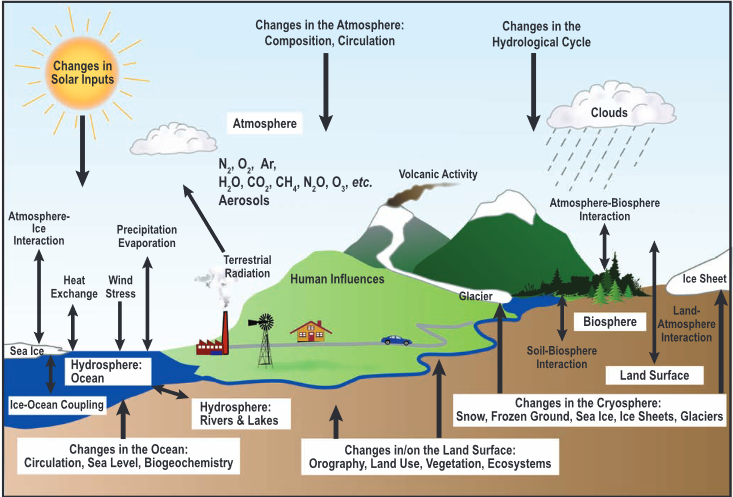
It’s not hard for the general public to understand much of what is presented in figure 2, as it represents what we experience in our daily lives with sun, clouds, rain, oceans, trees, houses, cars etc. Some of the terminology may need explaining depending on the individual’s education level and understanding. While figure 3 is aimed towards physicists or climate scientists to summarize and illustrate an energy balance.

Projection
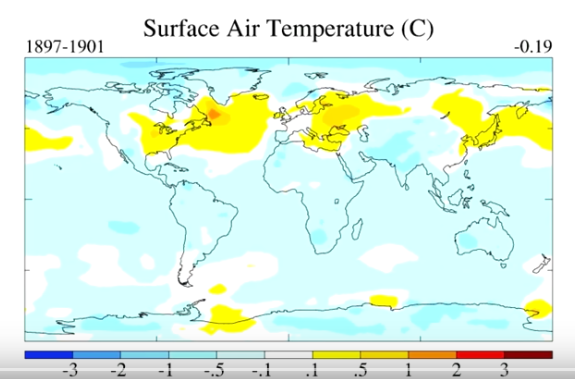
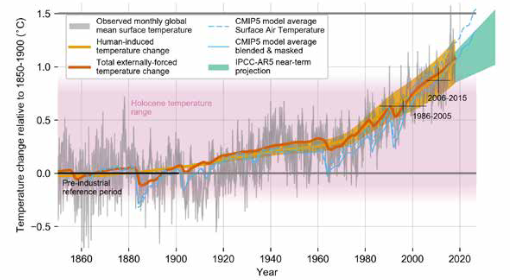
Models can be used to project expected consequences of an action (or inaction) whether it be related to climate change, economic performance or vaccination rates. The following models are for presentation purposes and effectively hides the very complex and computationally intense mathematical models which underlie the phenomena, which would be well and truly beyond the comprehension of the average person. Figure 4 is a snapshot of a computer simulation, an effective and graphical method using changing colours to illustrate historical and future changes in temperatures which general public or non-scientific population could easily appreciate. While figure 5 illustrates predictions based on trends that appears more aimed at the academic or scientist to understand. Note that figure 4 illustrates a degree of geographic location and effectively uses colour to drive a message. While figure 5 is global in outlook with numerical values of temperature change which to the general public may sound non-consequential, 1.5°C temperature increase doesn’t sound that bad!!!
Predictive
A model can be used to predict more direct and local consequences of events. Figure 6 is a map indicating sea level rise based on global temperature rise and the resulting flooding in Brisbane Australia. This particular model allows the user to choose a geographic location and global temperature rise to see the impact on that city. It ties together predictions of what the sea level rise would be due to ice melt and thermal expansion of oceans at various temperatures which incorporates very complex mathematical models and physics; and the coastal implications based on elevation above current sea level. The result is very simple to understand for the general public.
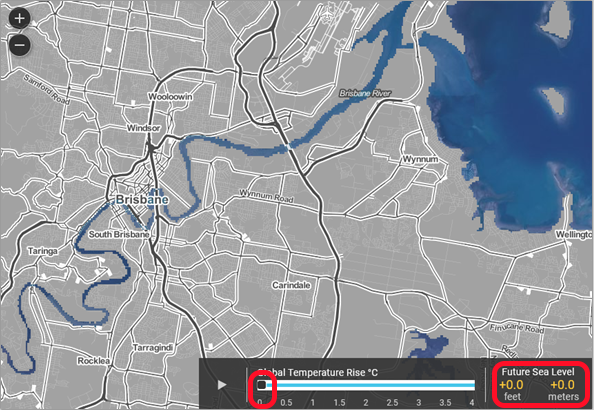
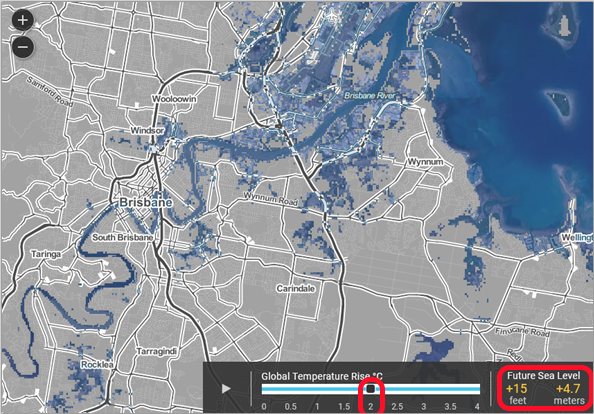
Figure 6: A predictive model of global temperature rise and its result in changing sea level. The user is able to see the impact by moving a slider on global temperature rise which updates the model and states future sea level. (Surging Sees Seeing Choices, 2022)
Scientific and Academic models
The natural sciences utilize various formats of models to describe theoretical phenomena which is aimed at very specific audience. Quantum mechanics or theoretical physics are disciples that rely heavily on mathematical modelling, yet these models are indecipherable and cryptic to all except a very small minority of physicists. The following three models are a representation of Einstein’s general theory of relativity which explains gravity as a distortion of spacetime (note spelling of spacetime is not space time!).

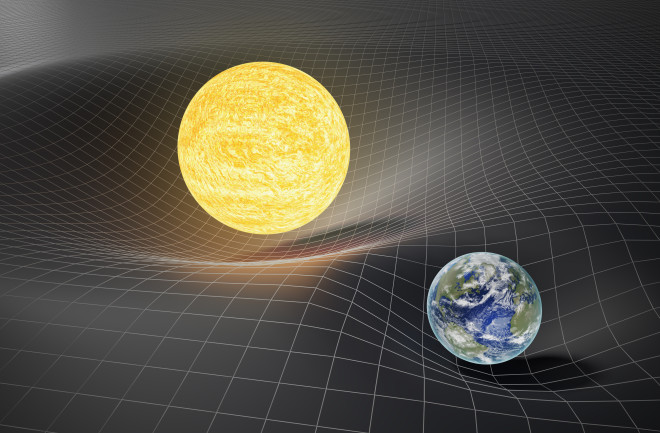
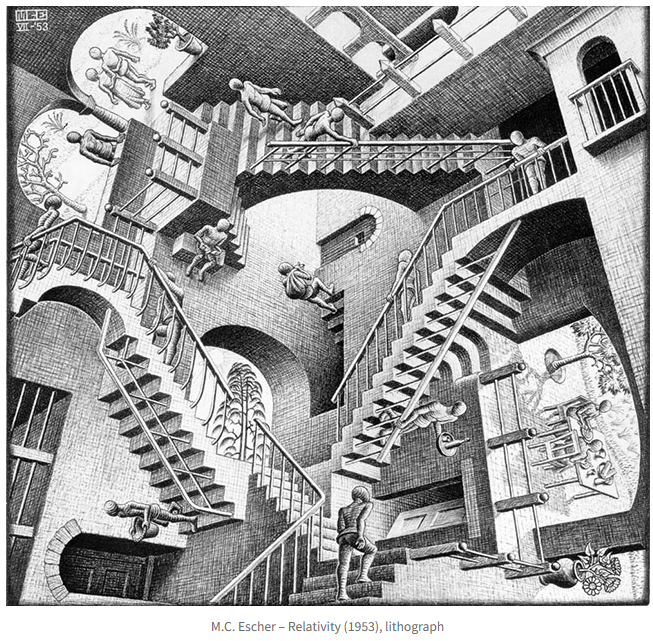
Figure 7 would mean absolutely nothing to most people, what is a field equation to start with!!! But it provides precision and accuracy and helps explain the subtlety in the orbit of the planet Mercury that Newtonian gravity could not. Even with that simple explanation figure 7 is totally meaningless to mere mortals. The visual model of figure 8 is something that more people could at least grasp the concept, even if they are somewhat challenged in a practical sense. In this model the reason that Mercury is so recalcitrant is not obvious. We also live our daily lives in a space and time context as per Mr Newton, not a spacetime context as Mr Einstein! Figure 9 being an artistic model may only place a smile on one’s face, but on deeper reflection it does convey ideas of things being relative to others and maybe not as they appear initially to the senses. It has been described as Visual imagery of a world where the laws of gravity have ceased to exist. (Relativity, n.d.) Or at least laws of gravity not being what we normally think it to be. Could this be a catalyst for some inquiring mind? This line of thought will be followed up in future sections on this site.
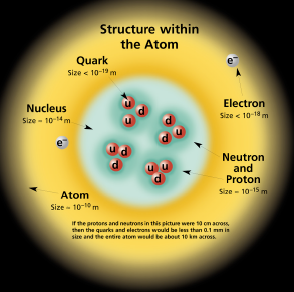

Figure 10 and figure 11 depict models at the sub atomic level of the spectrum referred to as the Standard Model in particle physics. Again each model transfers specific attributes and knowledge of the physically extremely small end of the natural world.
Models changing with time
Over time models can and do change in complexity and sophistication with innovative thought and insight; advances in knowledge of the domain; availability of computational power; and/or increased sophistication of scientific equipment to capture and measure data. For example, mathematical climatic models improve with increased domain knowledge (see figure 12), simultaneously with increased computational power and scientific equipment (see figure 13).

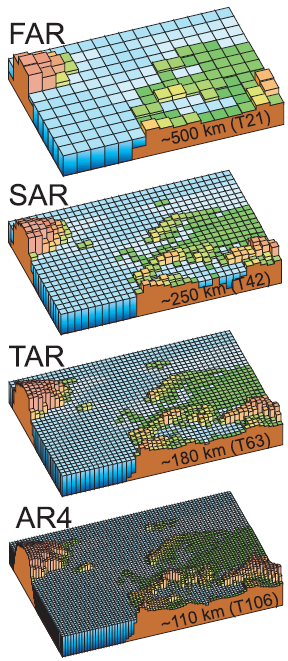
Different models for different contexts
An evolving or changing model does not necessarily result in a newer model replacing or making redundant an older model. A case in point is Newton’s definition of space and time versus Einstein’s definition of spacetime and the implications.

Figure 14: Still from Bartel, See Gravity Probe B (6:00)

Figure 15: Still from Bartel, See Gravity Probe B (6:03)
Upon Einstein imagining and formulating his concept of spacetime along with a multitude of experiments validating the general theory of relativity, aeroplanes and motor cars which were designed and built with Newtons Laws of Motion in mind did not career out of control. In fact, Newtons Laws of Motion are still used to great effect today. It is when extremely large bodies, such as the sun, planets or galaxies are involved that Einstein’s model can take account that these bodies can affect the shape of space and the flow of time in their vicinity. For extremely small bodies such as electrons or bodies moving close to the speed of light it is models of quantum mechanics that are required.
Are models ever wrong
A model can be conceptually wrong which can prove to be disastrous or it may be inconsequential. For example, a very simple model that proved to be disastrously wrong with incalculable impact on the lives of citizens was the “miasmatic” explanation of the cause of disease that prevailed in the western medical profession for much of the 19th century and into the 20th century.
This belief held that most, if not all, disease was caused by inhaling air that was infected through exposure to corrupting matter. Such matter might be rotting corpses, the exhalations of other people already infected, sewage, or even rotting vegetation. (Stephen Halliday 2001)
The miasmatic explanation created a mental model that resulted in “the solution” being that it was more important to remove smells from dwellings than to purify drinking water. Therefore in the 1840’s, waste from dwellings involved dispatching London’s waste in the direction of its water supply. Today the theory and resulting models of disease detection, treatment and prevention has evolved unrecognizably since miasmatic theory. While prior to the 1800’s serious and disabling diseases were attributed to supernatural origin with the following “cures”.
They might be the result of a spell cast upon the victim by some enemy, visitation by a malevolent demon, or the work of an offended god who had either projected some object—a dart, a stone, a worm—into the body of the victim or had abstracted something, usually the soul of the patient. The treatment then applied was to lure the errant soul back to its proper habitat within the body or to extract the evil intruder, be it dart or demon, by counterspells, incantations, potions, suction, or other means. (Britannica Online Encyclopedia)
Alternatively a model that is subsequently found to be incorrect may have inconsequential impact. The model of the “our” solar system being geocentric is obviously wrong as was believed since Aristotle’s days 4th century BC. It was in the 13th century AD that Copernicus proposed a heliocentric model of the solar system. A very interesting observation was articulated by Carlo Rovelli of a person who may have a correct idea versus showing how this idea fits into a bigger picture:
In the third century BCE, Aristarchus considered the possibility that the Earth rotated on its own axis and around the Sun. In light of the Copernican revolution, his idea was correct. Still, Copernicus and not Aristarchus deserves the credit for this revolution, because it was Copernicus who showed how this idea might work and how it could be integrated with the rest of our knowledge; he set in motion the process that eventually persuaded the rest of the world. It is easy to have ideas; it is difficult to pick out good ideas and find the arguments to show that they are “better” than current notions. Who knows how many human beings had imagined that the Sun passed beneath the Earth without, however, being able to change humanity’s worldview. (Rovelli, 2007, p. 60)
Rovelli points out the important difference that Aristarchus only considered the possibility of a heliocentric universe, while Copernicus went much further in showing how a heliocentric solar system may work. This challenged more than the thoughts of the solar system. Obviously this change of humanity’s worldview was problematic for many to accept, as it inferred the earth was not the centre which everything else revolved around and its impact on religious beliefs caused more than a ripple in society. This challenged personal beliefs and values, but it did not change anything in a practical sense. The sun still rose and set, the seasons continued, the stars still created a spectacle in the night sky. Therefore the question could be asked, what impact did believing in a geocentric model of the solar system have at this stage? Ruling out minor problems that you could be called a heretic and burnt to the stake!! This points to the fact that even with a well thought out model, many challenges exist in its acceptance and in its proof theoretically and/or experimentally.
Incomplete models
Then comes the prospect that a model may be partially correct, that is, correct only in a specific context. This was alluded to above with Newton’s Laws of Motion and Einstein’s Theory of General Relativity. There are many instances in the natural sciences where this has occurred, and in particular the solid foundations of the natural sciences of physics. Scientists have been attempting to define what are the fundamental building blocks of what we, the earth, the sun or the universe is made of has a long history which has resulted in the Standard Model as depicted in figure 10 and figure 11. Though it does not end there!
In physics the Standard Model (see figure 10 & figure 11) explains how the universe works and has for over 50 years. With few exceptions, it has stood up to this scrutiny, passing experimental test after experimental test with flying colors. This may suggest the Standard Model is complete and thorough. But this wildly successful model has conceptual gaps that suggest there is a bit more to be learned about how the universe works. (McGowan 2022)
Twelve matter particles interacting with three forces and a Higgs field. It’s a beautiful picture. The pinnacle of 400 years of science. But it’s clear that the Standard Model is not the last word in physics. Since the discovery of the Higgs boson, physicists like me feel that in many ways the Standard Model is too successful. It gives the right answer to every experiment that we do. Our current hope is that we will eventually find an experiment that it gives the wrong answer too.(Buder & Velasco, 2021. 13:07)
This captures the essence of scientific investigation and progress. Despite 400 years and the complete success of the current Standard Model, scientists are hoping for a failure! There is overwhelming evidence that the Standard Model is lacking as it does not include gravity, though recently phenomena called gravitational waves which are ripples in time and space itself. So even with Einstein’s theories and its accuracy in predicting motion of planets and solar systems, we do not actually know what gravity is. And here scientists are involved in far-ranging effort to find the point where Einstein’s model falls apart”.
With increasing technological capacity and knowledge, gravitational theories can be tested “in ways we’ve never been able to before”.
Jessica Lu, an astrophysicist at the University of California, Berkeley, said. “Einstein’s theory of gravity is definitely in our crosshairs.” (Deaton, 2019) Even the concept that gravity as one of four of the fundamental forces of nature is under scrutiny, some claiming that it is an emergent one. While other scientists are searching for signs of a fifth fundamental force of nature. In this world of physics which relies so heavily upon models of many descriptions and have contributed to the technology surrounding us today is actively searching to evolve their models even further.
Concluding thought
The previous two sections has looked at models and modeling from many different angles to hopefully highlight several points when it comes time to model wicked problems:
- Models are not static regardless of how mature and successful they may appear to be, they evolve constantly
- Evolution of models may occur due to increased domain knowledge; improved observation and data measurement; increased computational power; creative/innovative perspectives
- We cannot escape models as we always think in those terms
- Models can be formal models or mental models
- A model typically includes underlying assumptions which can also be modeled
References
- Bartel, Norbet. Gravity Probe B: Testing Einstein’s Universe, http://einstein.stanford.edu/Media/Testing_Einsteins_Universe-Flash.html
- Buder, E., & Velasco, A. V. (n.d.). The Standard Model might be the most successful theory in science. But what is it? Aeon digital magazine. Retrieved from https://aeon.co/videos/the-standard-model-might-be-the-most-successful-theory-in-science-but-what-is-it
- Cukier, K., Mayer-Schönberger, V., & Véricourt, F. d. (2021). Framers: Human Advantage in an Age of Technology and Turmoil. Penguin Random House UK
- Deaton, J. (2019, August 3). Einstein showed Newton was wrong about gravity. Now scientists are coming for Einstein. Retrieved from NBC News: https://www.nbcnews.com/mach/science/einstein-showed-newton-was-wrong-about-gravity-now-scientists-are-ncna1038671
- Fundamental Particles and Interactions. (n.d.). Retrieved from The Contemporary Physics Education Project: https://www.cpepphysics.org/fundamental-particles/
- Halliday, S. (2001, December). Death and miasma in Victorian London: an obstinate belief. BMJ, 323, pp. 1469-71. Retrieved from https://www.bmj.com/content/323/7327/1469
- Intergovernmental Panel on Climate Change. (2007). Climate Change 2007: The Physical Science Basis. Working Group I Contribution to Fourth Assessment. Retrieved March 2022, from https://www.ipcc.ch/report/ar4/wg1/
- Intergovernmental Panel on Climate Change. (2018). Special Report: Global Warming of 1.5C – Framing and Context. Retrieved from https://www.ipcc.ch/sr15/chapter/chapter-1/
- McGowan, Aaron. 2022. 2021: a year physicists asked, ‘What lies beyond the Standard Model?’. 6 January. https://bigthink.com/hard-science/2021-a-year-physicists-asked-what-lies-beyond-the-standard-model/
- NASA Climate Change. (2010, Jan 10). Climate Simulation of Surface Air Temperature. Retrieved from https://www.youtube.com/watch?v=l8M901ft20c&t=1s
- Relativity. (n.d.). Retrieved from Totally History: https://totallyhistory.com/relativity/
- Rogers, K. (n.d.). Scientific Modeling. Retrieved from Britannica: https://www.britannica.com/science/scientific-modeling
- Rovelli, C. (2007). The First Scientist: Anaximander and His Legacy
- Surging Sees Seeing Choices. (2022, March). Retrieved from Climate Central: https://www.beforetheflood.com/explore/the-crisis/sea-level-rise/
- Underwood, E. A., Richardson, R. G., Thomson, W. A., Guthrie, D. J., & Rhodes, P. (n.d.). History of Medicine. Retrieved from Encyclopedia Britannica: https://www.britannica.com/science/history-of-medicine
- Victoria State Government. (n.d.). Scientific models. Retrieved from Education and Training: https://www.education.vic.gov.au/school/teachers/teachingresources/discipline/science/continuum/Pages/scimodels.aspx
- Zdziarski, P. (2006). The Demand and Supply Curve. Retrieved from https://commons.wikimedia.org/wiki/File:Supply-and-demand.svg
 Wicked Paths