
The wise man doesn’t give the right answers, he poses the right questions
Claude Lévi-Strauss
Wicked problems require new approaches to compliment the scientific rational approach that successfully implements Science Technology Engineering and Mathematics (STEM) to achieve the desired changes in our physical world that compliments societies moral and ethical values.
In previous sections the requirement for many models to describe tame problems was illustrated and so it is with wicked problems. Rittel and Webber’s original definition of a wicked problem was a 15 page publication describing each trait in detail with background information. This was placed in a tabular format (see section Traits of Wicked Problems) as a summary, while some other models and descriptions were introduced in Evolution of Wicked Problems. Compared to the very rich and detailed models available and used in the natural sciences (Tame Problems), the area of modeling the concept of Wicked Problems appears to be still in an infancy stage, which is understandable considering Rittel and Webber’s paper was only published in 1973.
Models will be introduced here with the aim of providing ideas that others may use or modify to suit their requirements and context.
Comparisons can be useful to highlight differences or similarities with what is known or familiar. This may give leads as to how to approach a particular problem, or equally important how not to approach a particular problem. Where further investigation may be required or where ongoing monitoring could be pertinent. For example, tame problems focus on being rational and objective, whereas wicked problems are subjective and raises questions regarding rationality in such a situation. Is it that people are irrational or does rationality take on a different definition here?
A tabular comparison of tame problems against a wicked problem, could possibly look like the following:
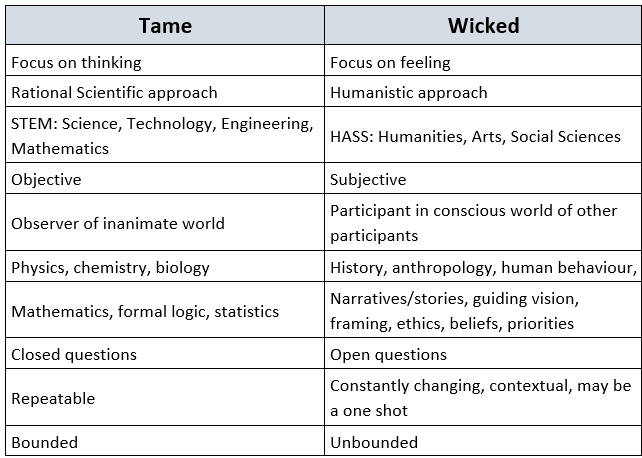
Figure 1 is one way to represent the differences between tame and wicked problems. This type of representation highlights differences and polarizes it into either a rational scientific approach for tame problems or an emotional and therefore irrational non-scientific approach for wicked problems! This rather stark representation is one that tends to be found in much of mainstream media; government or business leaders defending their positions on an issue; advertising (i.e., it has been clinically proven that . . . is better than the competitors); the importance given to STEM subjects over HASS in education; use of terms such as use of scientific best practices when making public policy. This tendency to polarize can also make an appearance by the scientific community or science communicators when it comes to social issues i.e., climate change, with statements such as “the science tells us . . . ”. Wherein a person can be automatically labelled a science denier if questions are raised. NOTE: Skepticism is built into the scientific activities as outlined in previous questions and should not be confused with denialism which appears to be a common symptom!!
A different approach will be proposed of a high-level framework that addresses traits that are present in all wicked problems. The approach taken will be to model wicked problems at the highest order in 3 dimensions. The axes as presented will have different focuses and details dependent upon the actual wicked problem being examined. Future sections on this site will be added breaking down the main high-level traits into greater details providing possible paths to greater understanding of the complete issue.
To start the ball rolling the proposed model is presented with initial descriptions and explanations.

Rather than fixed dimensions they will be context sensitive to the phase of the problem and timing. Therefore, more emphasis could possibly be given to Technical/knowledge and Power/influence and less to Motivation/values in early phase while at a later phase the Motivation/values aspects takes a more dominant role. One of the characteristics of wicked problems are the transient nature of them as conditions change either directly or indirectly. For example, the general economic situation may change drastically which happened with Global Financial Crisis; COVID19; or the war in Ukraine. These are extreme examples, but international events can change the situation for local issues. Changes for improvement may also occur, for example, with breakthroughs in science and technology resulting in economic efficiencies which is the goal of being innovative. The transient nature of many wicked problems leads to time being considered a fourth dimension. For now, will use the 3-dimensional model as shown depicting a snapshot in time.
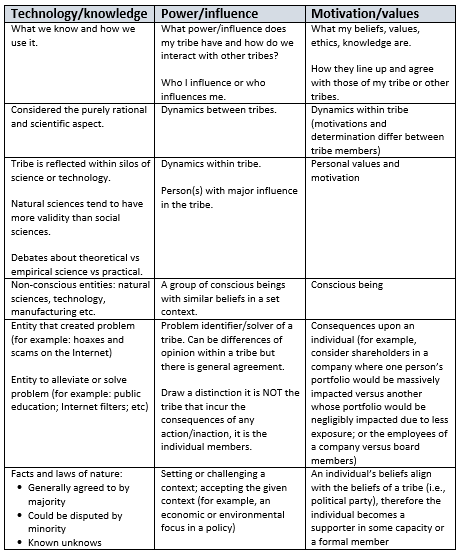
As a mental model there is nothing really controversial or contentious about this representation! Each and everyone of us have our own beliefs and values; we are all part of some tribe that influences or exerts some power over us, or alternatively we exert over them; we all have some knowledge or use technology. It is a mental model of convoluted relationships, for example, as a child grows they are influenced by teachers, family or friends. They form their own values and beliefs while receiving a formal education of some sort. The formal education may be from an academic perspective, religious group, or community elder. Later they may influence or have power over others. We all have some knowledge and use technology whether a smart phone or a pot to cook food. We form opinions about technology if we believe it is good or bad for us, so some believe that vaccinations are to be avoided while others accept it.
We may believe that science and technology is value free, but the real point is how mere mortals use science and technology. Knowledge in the fields of neuroscience, psychology and other areas of human behaviour study can help us understand individual and group behaviour for benevolent reasons. It can also be used for nefarious reasons! Many times it is used innocently to convince a person of some viewpoint or sell a product. One could ask what this website is all about!! It uses technology to publish thoughts and ideas; the author has values and motivations as do all authors; while being influenced by the thoughts and beliefs of others.
Technical/knowledge
The technical knowledge that is known or currently being researched and developed. Advances in scientific knowledge and understanding in all streams of the natural sciences has and continues at a breathtaking pace. This has led to products that are now commodity items in areas such as telecommunications and entertainment; leading edge medical services; etc.
This includes related aspects such as:
- manufacturing or distribution of a components/products;
- expertise in operating, maintaining or installing equipment;
- economically viable for the market or the intended use
- testing and safety issues
COVID-19 presented a powerful example in this respect. Vaccination expertise was available, but the vaccine had to be effective against the strain(s) of the virus and had to be safe while developed in a timely manner. Note some vaccines had to be kept at extremely low temperatures which was a challenge if not impossible for some remote communities. While new forms of delivering the specific vaccine via mRNA was also developed, though it should be noted that the mRNA technology was developed prior to COVID-19, it was never used previously in an actual vaccination programme.
For an issue such as COVID-19 there was and are differences of opinions regarding the safety and efficacy of vaccines. This aspect is of any wicked problem would be accommodated in the Power/influence axis and the Motivation/values axis.
We possess scientific knowledge in how fossil fuels are a major contributor to anthropogenic climate change. Although the degree attributed to fossil fuels and possible future projections and likely affects is debated, the consensus is that fossil fuels are a major contributor. We currently have technical knowledge regarding renewable energy sources and storage, which is increasing with regard to the technologies, manufacturing processes and costs. Technical and scientific work in all aspects of anthropogenic climate change is ongoing, impediments to progress of alleviating this issue are reflected in the other two axes.
The section Innovation is currently under construction on this website that will cover many of the types of details mentioned here in greater detail.
Power/influence
An important aspect of power/influence is captured by Amy Chua: Humans are tribal. We need to belong to groups. We crave bonds and attachments, which is why we love clubs, teams, fraternities, family. Almost no one is a hermit. … tribal instinct is not just an instinct to belong. It is also an instinct to exclude. (Chua, 2018) Some examples of tribal nature that is conspicuously evident:
- Hyper-partisanship of political parties
- National Rifle Association (NRA) on gun control in the USA
- Response to COVID-19 with regard to vaccinations and mask wearing
- Human rights with regard to abortion; assisted dying; or gay rights
In recent times tribal nature appears to be gaining precedence and exposure aided by social media and 24 hour news reduced to sound bites.
Power and/or influence can be enacted in various contexts:
- company manager over an employee
- government minister enacting legislation
- cult leader over followers
- influential as in role models or the phenomena of influencer on social media
- friends, family, community leader and colleagues
- professional person such as medical person or respected scientist
This can also be considered in the context of an organization without reference to any individual(s):
- Pharmaceutical industry, energy industry, etc.
- Law
- Scientific
- Media
- Governments
The above is often portrayed as the us versus them. It is common to hear any number of conspiracy theories against the Pharmaceutical industry especially as recently with COVID-19; the labeling of fake news or mainstream media; the perceived attack on science and many more. It is important to note that some of these accusations do have some truth to them due to bad behaviour of some individuals or organizations. The problem arises when this is generalized and exaggerated to suit a motive or agenda.
The section Human Behaviour will be created on this website that will cover many of the types of details mentioned here in greater detail.
Motivations/values
How and if this will affect me and what I do about it if anything.
Everything that makes us human! Humanness! Imagination and curiosity; determination; beliefs and values. How a person views the impact of action or no-action on them. Important note is this can be driven by feelings NOT necessarily factual information.
Brings in other aspects such as:
- Maslow hierarchy of needs
- Finite pool of worry
- Expectations
- Determination/grit (i.e., 99% perspiration; 1% genius)
The section Human Behaviour will be created on this website that will cover many of the types of details mentioned here in greater detail. Rittel and Webber used the term the competing publics
Comments on the model
Stakeholders
The concept of stakeholders is one that features heavily in business, government and academic research when considering strategies or policies. It was first coined by Ansoff (1965), but it was not until the publication of Strategic Management: A stakeholder approach, Freeman (1984) that the concept started to be used more widely. Alford & Head use it in their model (see Alford & Head Model), while Turnbull & Hoppe also use the term stakeholders and promote using policy sciences vocabulary. Stakeholders appears to be a policy and business oriented buzzword now! Why not simply use stakeholders rather than the Power/influence and Motivation/values as used in this model?
A research paper published by (Bussy & Kelly, 2010) had important two findings:
- . . . in politics, as in business, controversy and confusion continue to surround the stakeholder concept
- . . . power seems to play a far greater role than legitimacy in determining stakeholder salience among political decision-makers
(Bussy & Kelly, 2010) continued with . . . the problem of the democratic deficit and its attendant consequences, most notably a decline in the level of public trust in politics and a growing sense of citizen alienation from the political process. Declining public trust in politics and citizen alienation appears to a growing phenomenon. Compare this to Rittel and Webber’s 1973 paper claiming In the courts, the streets, and the political campaigns, we’ve been hearing ever-loader public protests against the professions’ diagnosis of the clients’ problems, against professionally certified standards for the public services. Fifty years later and there has not been any improvement, in fact, trust in democratically elected officials has decreased substantially. In 1972, trust in USA government stood at 53% (Nixon prior to the Watergate scandal) while for the last three USA presidents of Obama, Trump and Biden, trust has plummeted to between 23 to 17%. Compared to Eisenhower, Kennedy and Johnson where the moving average stood between 77 to 62%. (Pew Research Center, 2022) As per the opening page of this section, it is not only scientists feeling unloved!!!
A result of . . . power seems to play a far greater role than legitimacy in determining stakeholder salience among political decision-makers. Who has power is imperative to know as not only can that be used to influence decision makers it also plays into the hand of effectively crowding out other legitimate groups that may not be organized or resourced. It appears there are many groups with legitimate interests who are effectively excluded from the consultative process because they are largely unorganised and hence lack the power to command the attention of the political elite. (Bussy & Kelly, 2010)
This is one area that requires more research in how stakeholders are identified; what influence they do have; and what of the unorganized but legitimate groups. What are the motivations and beliefs of these stakeholders in important to appreciate as it will be a major driver in their actions. Today with social media, actors who may not be legitimate stakeholder and have their own hidden agendas, can and do have a major influence on the legitimate groups or individuals. Witness such events as the COVID-19 epidemic and misinformation.
Social media, shock jocks, sensationalized tabloid press, are galvanizing public opinions particularly at a time “the largely unorganized . . . lack the power to command the attention of the political elite.” The largely unorganized can turn to social media to feel they are heard to vent their frustrations.
In another research paper (Jensen & Sanderström, 2011) claim Globalization is a blind spot in stakeholder theory and this undermines its explanatory power and usefulness to managers in global corporations. Also that . . . in recent decades theorizing on stakeholders has drifted towards a take on stakeholder theory that . . . and that is ‘overtly hostile to ethics’.
Stakeholders can be categorized as summarized by (Fernando & Lawrence, 2014) given below:
- strategic and moral stakeholders
- external and internal stakeholders
- latent, expectant, and definitive stakeholders
- subgroups of stakeholders such as shareholders, employees, and customers
- single issue, and multiple issues stakeholders
- supportive, marginal, nonsupportive, mixed blessing stakeholders
- voluntary and involuntary stakeholders
- primary and secondary stakeholders
Each stakeholder has some motivation for taking a stand or position on an issue, as it has some impact on them. This impact could be related to financial, ethical, health, ego, or any number of reasons. Equally each stakeholder would have some power or influence over decision makers or public opinion. No person or group would be completely immune, it is only a question of in what manner and how much they are influenced or biased. Note the controversy in the United States regarding the make up of the judges in the Supreme Court of the United States. This is also true of scientists, government officials, journalists, community leaders and of course the current person reading this!!! We all have our belief system and biases.
Having some understanding of not just naming a stakeholder but of their possible motivation and power to influence could be an important “detail”. For example, the tobacco companies were stakeholders in the health debate on smoking in public places, as was the medical profession, and the government where they may have benefited via taxes on cigarette sales. Currently the fossil fuel industry takes part in the debate regarding climate change and actions to take (or not take), they are certainly stakeholders, but how much influence should they have? It is easy to argue that justice has been served with the opioid lawsuits in the USA being settled for billions, but unfortunately for most,if not all those affected, it is too late.
In the age of social media and where public opinion is a driver of policy it does become extremely difficult if not impossible to identify who the “influencer” is, or if identified it is hard to fight such influencers.
Problem restructuring
Turnbull & Hoppe strategy is to view problems as unstructured that need to be structured: The key insight here is what dealing with policy problems means: problem structuring . . . i.e. moving along the continuum from unstructured toward more (or less) structured problems Turnbull & Hoppe. They present a methodology that is somewhat similar in general scope and detail to the Scientific Methodology previously presented and critiqued, (repeated in figure 4 for convenience). The comments made regarding the Scientific Methodology are therefore relevant to Turnbull & Hoppe’s methodology.

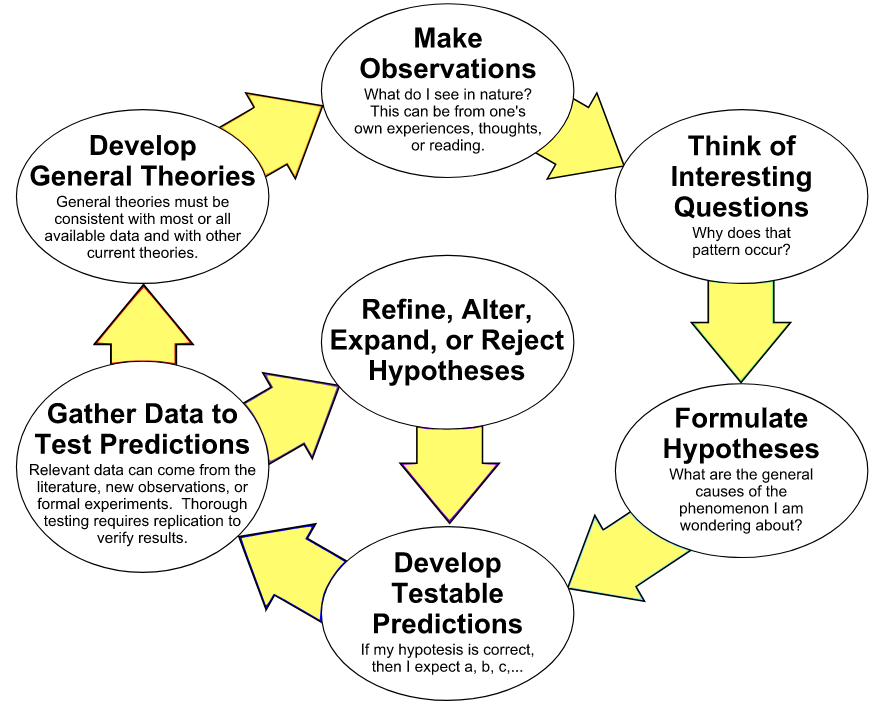
To reinforce previous comments regarding the Scientific Methodology, it is not that the above are incorrect, they only illustrate a general scope and are limited in usefulness in the actual process of “problem solving” in the field.
No silver bullet
In prior sections the idea of any one single methodology or model to solve tame problems was shown to be a myth, as is the idea that methodologies and models are static in nature. The importance lies with the imagination; understanding of the context; persistence to continually challenge; and humility to realize there will always be different ideas and viewpoints equally correct. The model and ideas presented here should be considered just one path, one of many wicked paths, that could be taken and critiqued, modified and extended to suit a context. Even if this model is simply a catalyst to other improved models and ideas, then it has done its job. The dynamic nature of the natural sciences has led to technologies that have transformed our world with “things”. Some of these “things” has led to socially undesirable outcomes such as increased polarization of societies aided by social media and the disgruntled and unorganized people.
Coming up
Other pages will be added to this section with some examples of how it is envisaged this particular model could be used in cases such as the Manhattan Project introduced earlier. As other sections (i.e., Human Behaviour, Innovation, Framing, etc) of this website evolve, further examples with be added to this section. Recall that people think in terms of mental models and how to organize their thoughts, it will be with the addition of the other sections that examples and ideas will presented that may be used to assist with resolving wicked problems that do fall in with the 3 dimensional model as presented here.
References
- Alford, J., & Head, B. W. (2017). Wicked and less wicked problems: a typology and a contingency framework. Policy and Society, 36(3), 397-413.
- Ansoff, I. (1965). Corporate Strategy.
- Freeman, R. (1984). Strategic management: A stakeholders approach.
- Bussy, N. M., & Kelly, L. (2010, November). Stakeholders, politics and power: Towards an understanding of stakeholder identification and salience in government. Journal of Communication Management.
- Fernando, S., & Lawrence, S. (2014). A Theoretical Framework for CSR Practices: Integrating Legitimacy Theory, Stakeholder Theory and Institutional Theory. The Journal of Theoretical Accounting, 10(1), 149-178.
- Jensen, T., & Sanderström, J. (2011). Stakeholder Theory and Globalization: The Challenges of Power and Responsibility. Organization Studies, 32(4), 473-488.
- Pew Research Center. (2022, June 6). Public Trust in Government: 1958-2022. Retrieved from https://www.pewresearch.org/politics/2022/06/06/public-trust-in-government-1958-2022/
- Rittel, H. W., & Webber, M. M. (1973). Dilemmas in a General Theory of Planning. Policy Science (4 (1973), 155-169).
- Turnbull, N., & Hoppe, R. (2019). Problematizing ‘wickedness’: a critique of the wicked problems concept, from philosophy to practice. Policy and Society, 38(2), 315-337.
 Wicked Paths