
Despite the current obsessions of academics, governments or businesses; the concept of innovation has an extremely long history. Viewing this history uncovers certain traits of innovation that have existed since the earliest Greek origins of the concept of innovation. Traits that clarify the concept of innovation rather than the confusion of relying on a simplistic definition of innovation as a buzzword.
People may be under the impression that innovation is a recent phenomena in our technologically driven economic environment. Therefore ideas of what innovation means is typically formed within this context of consumer goods and market economy. Within this context it is very ambiguous what innovation actually is beyond a simplistic definition as has been previously shown.
Stepping back to view some examples of what many would agree to as being innovation spanning decades and centuries helps in identifying certain traits independent of time scale. Starting with the mobile phone which is now a consumer good, it is recognized as being an innovative product, created by innovative companies, and typically associated with creative, innovative visionary business leaders.
Looking a bit deeper into the mobile phone and what makes it mobile reveals other hidden levels of innovation (at least to the average consumer). These hidden levels uncover a nuanced understanding and appreciation of what innovation is within a broader sense. It sheds light on what is required to achieve innovation and how failures are an important and unavoidable part of the total innovation process.
We like to romanticize it and imagine supergeniuses in the comfortable surrounds of a well-appointed laboratory waiting for lightning to strike. In reality, innovation is messy. It happens inside buildings with leaky roofs. It happens under the pressure of customer timelines. And it happens when you’re trying to solve problems—even those created by yourself. (Cooper, 2020)
The above description of the innovation process was given by Martin Cooper, identified as the father of the cell phone. It is only one descriptions given by someone identified as an innovator, the key term he used was romanticize which I believe many people have. This leads to equally simplistic beliefs in how to produce or measure innovation.
The following introduces certain aspects of the mobile phone with lots of pictures, nothing too deep or technical, but aiming to illustrate the concept of innovation in different contexts, such that a more informed and nuanced appreciation is gained. This will help in building a more thorough concept of innovation.
Mobile phones
The simplest illustration of innovation can be seen in the humble and ubiquitous mobile phone. Everyone has one, don’t they? Some people seem to not be able to function without one, it can cause anxiety and distress to lose, misplace or simply forget ones mobile phone.
A current mobile advertisement speaks volumes of how critical they are to ones life!! As shown in Figure 1, the functionality of the mobile phone that is advertised to help one get through the day is impressive! While this only shows one section of the advertisement. The other sections include the following with lots of enticing words and glossy pictures:
- Camera
- Video Recording
- Mobile and Wireless
- Video Recording
- Audio Calling << you can actually make a telephone call!!
- Audio Playback
- Video Playback
- Siri
- Languages
It’s good to see that Audio Calling does make it onto the list of features!
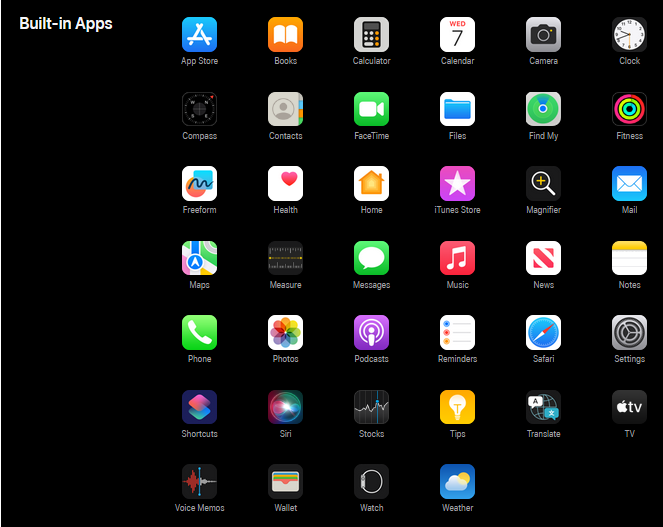
No better example of current mobile phone technology is to be seen in your pocket. Assuming you have a mobile phone that is no more than a couple years old!
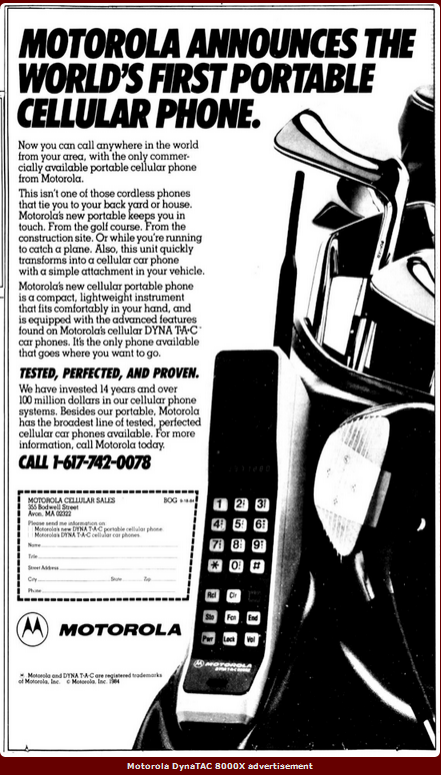
Contrast your mobile phone to the first released cellular mobile phone in March 1984 as illustrated in Figure 2
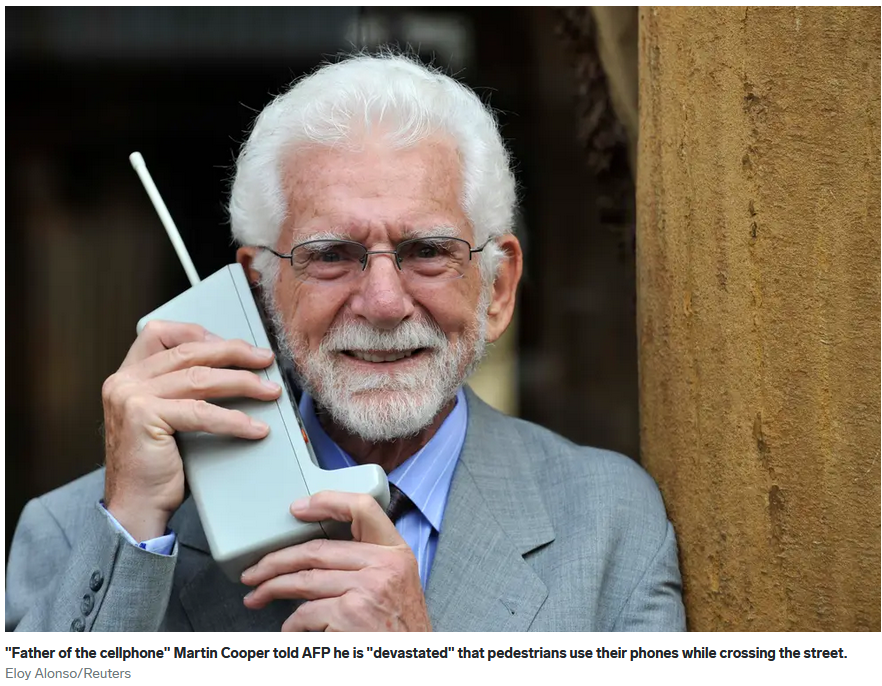
Figure 2a: Dr. Martin Cooper referred to as the “Father of the cellphone”. The first call over a cellular network was in 1973. It would be a decade later in March 1984 the Motorola DynaTAC 8000x was released. (Time 2010; Business Insider 2023)
Figure 2b:The advertisement for the world’s first portable cellular phone. Compare that to the plethora of stated features for current smart phones, for example the Apple iPhone.
In July of 1973 a feature article in Popular Science it was stated With Federal Commission approval, the Dynatac system may be operating in New York by 1976 (Free 1973). It was eventually released to the public in March 1984, just over a decade later! Much more will be covered in this time delay later, for now it will simply be referred to the “Valley of Death“. In the space of around 40 years from the first mobile phone to today’s wonder gadgets labeled smartphones,
| Feature | Motorola DynaTAC 8000X | Apple iPhone 14 Pro |
| Announced | 1984 | 2023 |
| Weight | 790 grams 30 ounces | 206 grams |
| Size | H: 230 mm (Not including antenna) W: 44 mm D: 89 mm | H: 147mm W: 71mm D: 8mm |
| Battery capabilities | 30 minutes before needing recharge 12 hours standby mode; About 10 hours to recharge | Video playback: up to 23 hours Audio playback: up to 75 hours Up to 59% charge in 30 minutes |
| Price (US $) | $3,995 (equivalent to $11,500 in 2023) | $999 |
| Built in memory | None | From 128 GB up to 1 TB |
| Features other than audio phone call | None | Yes well . . . may be just a couple of other things it can do. Though I don’t think it can make a good cup of coffee. Not this model anyway, next model maybe !! |
With the evolution of the mobile phone as depicted above, it is quite easy for most people to appreciate that in this comparison, the iPhone is at the pinnacle of innovation (for now at least and noting that the iPhone 15 is now available). It represents the progress of innovation that has taken place in around the 40 years time-frame, from the basic DynaTAC to a true mobile device with an impressive list of features, technology, and importantly price affordability. Simplistic comparisons as Table 1 illustrates, makes it easy to sell the concept of innovation to the masses. But is it as easy as the marketing team asking for new features since they have done their research on the matter, and the engineering team supplying those features?
Technology incorporating electronics which is continually improving in size (or more precise, shrinking in size), processing power, functionality, and price seems to be a good place to start looking at what innovation may actually mean.
What of the “magic” inside the mobile phone? Behind the guise of a device that can be held in the palm of the hand what innovation lurks behind the hard plastic covering and display. Looking inside the mobile phone would fill many books with extreme technical jargon, that won’t happen here. Rather a brief look at certain aspects or components that goes into making a mobile phone, or any sophisticated electronic device we use everyday for that matter.
The “magic” inside
Processor, memory and storage are technical terms people may come across while searching for their next mobile phone along with price of course. These are core components of any telecommunications device that enables a mobile phone to be . . . well mobile and affordable!
This is only possible due to unrelenting progress made in solid state physics and many related disciplines of science and engineering. Without solid state physics and associated manufacturing processes, your mobile phone would be neither mobile nor affordable.
Before phones were mobile
Taking a step back in time before phones were mobile and charting a brief path of the progress made to current day can put a smile on ones face. Seeing what was current state of the art as far as electrical devices. Most of us have at least heard of terms such as transistor, integrated circuit, or processor. Going back several decades things were just a “little” bit different!
Two areas will be covered of the difficulties and subsequent solutions to provide some historical reference to the device you now hold in the palm of your hand capable of connecting to anyone in the world at any time. (Well that does depend on your provider does have coverage in the areas in question!)
Slight Digression
This concept was first conceived of in 1907, not long after Alexander Bell invented the telephone (see note 1, who invented the telephone). It was Theodore Vail, the president of AT&T that coined the phrase “one system, one policy, universal service”. In this context a “Universal Service means a telephone network that covers all of a country, is technologically integrated, and connects as many citizens as possible.” (Milton Mueller) That pretty much applies to today’s telecommunications, it covers the globe, is technologically integrated, and does connect everyone with everyone else, provided you have a mobile phone.
It is noted that Vail’s motivations for Universal Service was not as simply interpreted as given above. Rather it was fragmentation between the Bell System and Independent companies that could not connect to one another. Therefore competition was of two separate telephone systems in a city or town, where subscribers on one system could not connect to subscribers on the other system. This required subscribers, typically business to subscribe to both systems!
Mueller concludes:
Vail and other Bell spokesmen decried the fragmentation and duplicate subscriptions caused by competing telephone exchanges. Independents defended the fragmentation as a small price to pay for the price restraints, service improvement, and innovation promoted by competition.
“Universal service” was put forward in that environment by the Bell System as a policy alternative to dual service. To Bell, the term meant consolidating competing telephone exchanges into local monopolies so that all telephone users could be interconnected. It did not mean a telephone in every home, affordability, or government policies to subsidize telephone penetration.
It is interesting that the Independents highlighted the idea of innovation as one of their justifications. We have crossed the issue of non-compatible systems and innovation with regard to modern telecommunications. A slight digression was made above, the interested reader is referred to Mueller who addresses various competing interpretations of “Universal Service”.
There were many major technological problems that needed to be overcome to enable a service where one individual could connect to another individual and have a clear conversation with each other. Two of these problems were line attenuation and
Attenuation: Bell Telephone Quarterly January 1940 pages 8, 35 “Service was Limited at First by Several Factors”
Getting back to
Considering that the birth of solid state physics was 1947 and telephones
Then in 1947 was the discovery of solid state physics what would become the precursor to the transistor (see figure XXX). In time discrete transistor components were manufactured to replace the aging vacuum tube (see figure XXX), but this did not happen immediately.
Figure XX: shows the state of the art of a vacuum tube that was an essential part of the telephone system in the early 1920’s. This had obvious problems of physical size; energy used and heat generated (put your hand on the old incandescent light bulb); and fragility of a glass bulb and hot wires.
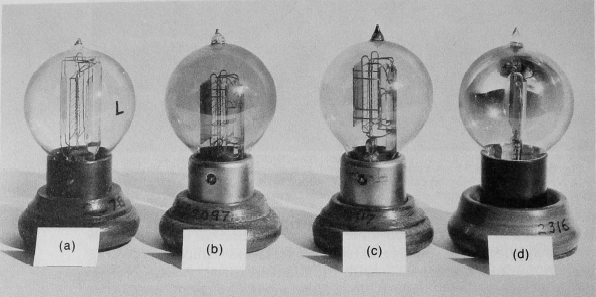
Changes to the vacuum tubes included lowering operating temperatures, increasing amplification, increased life expectancy. But is wasn’t until 1947 that the replacement technology for vacuum tubes made its first appearance.
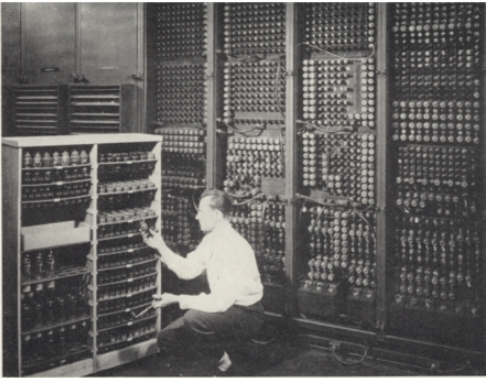
While about 19,000 modern improved vacuum tubes were used for the world’s first electronic digital computer named ENIAC.
Transistor

The point contact transistor – a component that can act as a switch and an amplifier. The inventors John Bardeen and Walter Brattain were aiming to develop a smaller electrical device to improve telephone calls. (Nokia Bell Labs 2022)
“If you were using vacuum tubes instead of these transistors, this cell phone would be ten times the size of the Empire State Building,” (Nokia Bell Labs) and you may have thought the original car phones were large and expensive.
Integrated Circuits
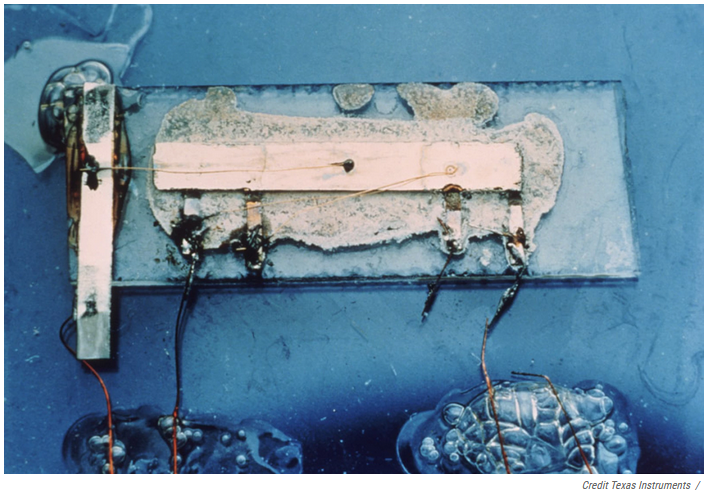
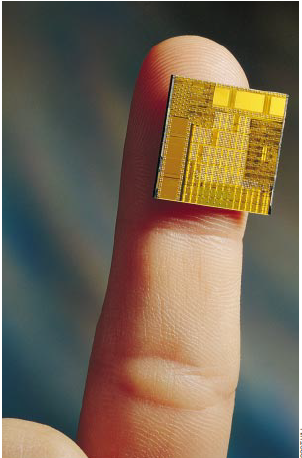
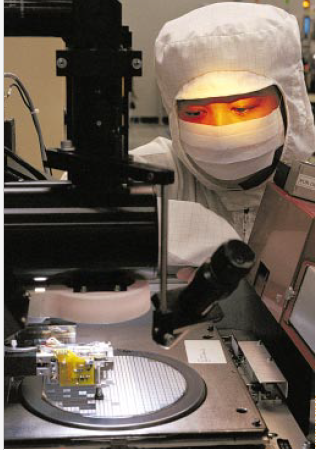
Eventually having discrete components was a limiting factor in progressing electronic devices which resulted in the invention of the integrated circuit in 1958. Devices originally only containing a few transistors quickly escalated to transistors numbering in the tens, then hundreds at which point it became extremely difficult to assemble and solder that many transistors onto a circuit board and the resulting high failure rates.
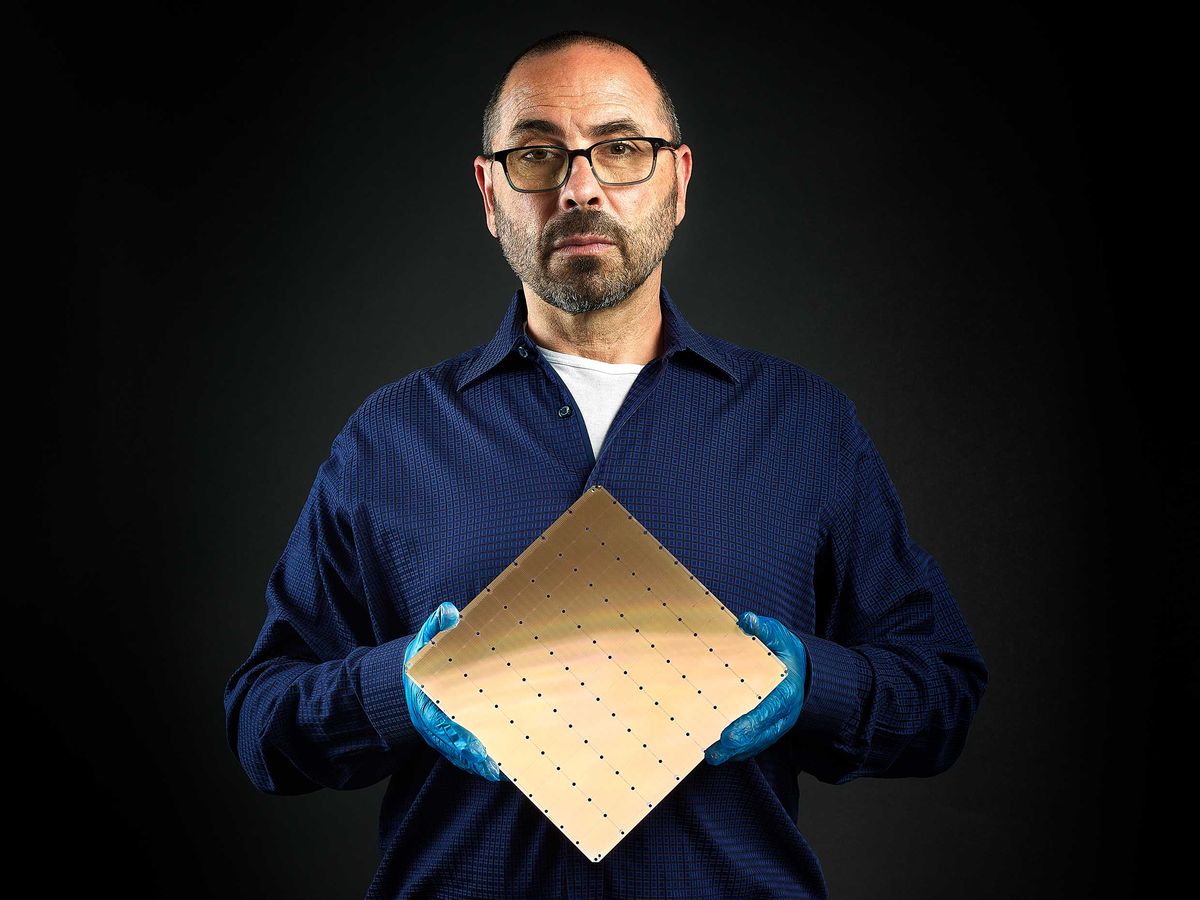
| WSE 2 | WSE | Nvidia A100 | |
| Size | 46,225 mm2 | 46,225 mm2 | 826 mm2 |
| Transistors | 2.6 trillion | 1.2 trillion | 54.2 billion |
| Cores | 850,000 | 400,000 | 7,344 |
| On-chip memory | 40 GB | 18 GB | 40 MB |
| Memory bandwidth | 20 PB/s | 9 PB/s | 155 GB/s |
| Fabric bandwidth | 220 PB/s | 100 PB/s | 600 GB/s |
| Fabrication process | 7 nm | 16 nm | 7 nm |
| Greek origin – kainon (novelty)
Kainotomia – (making new cuttings) |
Neoterizein
neoterismos |
Kainotomein
kainopoein |
|
| 5th century BCE | |||
| Xenophon (430–355 BCE) | Plato | Aristotle | Polybius (200–118 BCE) |
| Problem: Few mining projects as labour is short, silver in strong demand, private individuals need to diminish risk of labour | Problem: culture (education, customs)
Introducing some novel device. Make young despise old things and value novelty. Leads to political instability |
Problem: Political change | A historical writer He talks about innovation not of innovation |
| Solution: State possess public slaves and make available for hire to entrepreneurs in mines. | Solution: Need to contain or control innovation | in politics, most good changes have already been made | |
| Outcome: Make city strong, people happy and more physically trained, more obedient, better disciplined and more efficient.
Live in greater security and be more glorias |
Outcome: Soul is filled with such respect for tradition that it shrinks from meddling with it. | All possible forms of organization have now been discovered. If another form of organization was really good it would have been discovered already | |
| Risks: To reduce State risks proceed gradually. | |||
| Neutral sense | Pejorative sense, political and subversive connotation | Pejorative sense, political and subversive connotation | |
References
- Apple iPhone. iPhone 14 Pro Specs
- Cooper, Martin (2020) Cutting the Cord: The Cell Phone has Transformed Humanity
- Fagen M. D. (editor) (1975). A History of Engineering and Science in the Bell System: The Early Years (1875-1925)
- Free, John R. (1973). New Take-Along Telephones Give You Pushbutton Calling to Any Number. Popular Mechanics. July 1973, Vol. 203. No. 1 Available via Google books
- Godin, B. (2008). In the Shadow of Schumpeter: W. Rupert Maclaurin and the Study of Technological Innovation. Project on the Intellectual History of Innovation, Working Paper No. 2.
- Godin, B. (2012). Social Innovation: Utopias of Innovation from c.1830 to the Present. Project on the Intellectual History of Innovation, Working Paper No. 11.
- Godin, B. (2015). Innovation Contested: The Idea of Innovation over the Centuries. Routledge.
- Mueller, Milton (1997). Universal Service: Competition, Interconnection, and Monopoly in the Making of the American Telephone System
- Nokia Bell Labs. (December 2022) The transistor: 75 years since the famed Nokia Bell Labs invention changed the world.
 Wicked Paths