
Analogies can provide useful perspectives on a complex concept
An analogy quoted as the very first paragraph in one publication: A technological innovation is like a river — its growth and development depending on its tributaries and on the conditions it encounters on its way. The tributaries to an innovation are inventions, technologies and scientific discoveries; the conditions are the vagaries of the market-place. (Braun and Macdonald 1978)
Expanding on this analogy as given above, to one of the hydrological cycle uncovers hidden aspects of how innovation could be viewed. The hydrological cycle has many feedforward and feedback paths that are highly interdependent while it is easy to visualise and illustrated these dependencies in a figure such as shown below. The average person would also be familiar and understand many of the processes and concepts used without knowledge of the physics and/or chemistry involved.
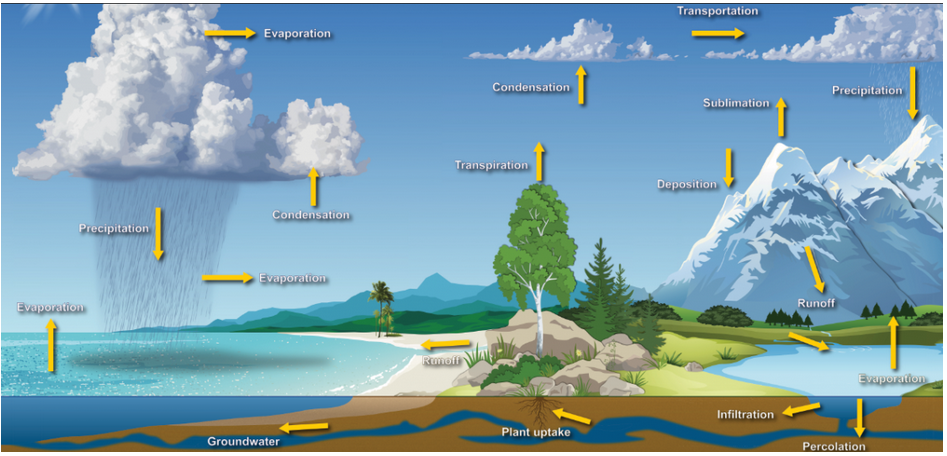
As covered elsewhere, the concept of innovation is either simplified to such as extent that it is misleading or becomes a catchall term to solve every economic or technical problem encountered. Innovation will be considered as a cycle similar to the hydrological cycle with multiple feedforward, feedback and interdependencies, in effect an innovation cycle.
| Innovation cycle | Hydrological cycle |
|---|---|
| The market – supply and demand of end consumer goods. Smartphone is in the market place exposed to all the market pressures, customer expectations, satisfaction, understanding; direct competitors; competitors being replaced (land lines, non-gui mobile phones, etc) | Ocean |
| Specialized market – integrated circuits, Wi-Fi protocols. Not actual end products of themselves, used within end products. | Lakes |
| Manufacturing technology, raw materials supply – how to manufacture and supply integrated circuits | Runoff from mountains and valleys
Tributaries into lakes Tributaries from one lake into another |
| Implementation knowledge – engineers/designers learning how to use integrated circuits to design end consumer goods. Putting all the pieces together to create the final consumer good the Smartphone | Rivers and streams running into lakes and the ocean |
| Market knowledge – entrepreneurs, investors, marketing benefits to customers | |
| Fundamental innovation; fundamental research unknown if and when will required or useful beyond point of discovery. Einstein’s Theory of Relativity | Mountain ice caps |
| Cyclic and iterative process at every point. Innovation process is not linear. Has feedback and feedforward aspects | Condensation, Transpiration, sublimation;
Evaporation, transportation; Deposition precipitation |
| Human imagination and motivation to cause action | The Sun |
Table 1 Innovation cycle versus Hydrological cycle
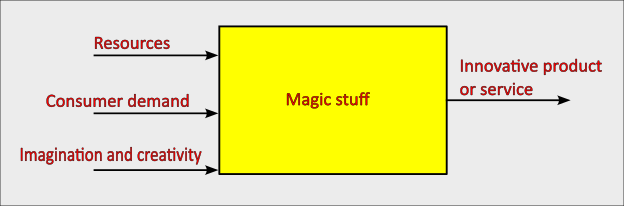
A simplistic model of innovation
References
- Braun, E., & Macdonald, S. (1978). Revolution in Miniature: The history and impact of semiconductor electronics. Pitman Press
- National Oceanic and Atmospheric Administration. (n.d.). Water cycle. Retrieved from https://www.noaa.gov/education/resource-collections/freshwater-education-resources/water-cycle
 Wicked Paths