
The original concept of Wicked Problems is further researched and evolves. Some examples of how researchers have treated the subject.
The concept of a wicked problem has evolved since its inception by Rittel and Weber in early 1970’s and will undoubtedly continue evolving in how it is described in a variety of contexts, and the tools available in dealing with them in practice. The concept of science has evolved over the centuries since The Scientific Revolution starting in the early sixteenth century. Many would argue that science has been with us for millennia, depending upon how science is defined. Is science the pattern of behavior by which humans have gained control over their environment; or distinguish between science and technology, science as a body of theoretical knowledge, technology as the application of theoretical knowledge to the solution of practical problems. (Lindberg, 1992) Regardless the concept of wicked problem still has a long journey ahead!
The concept of Wicked Problems in comparison with Tame Problems (which typically related to the natural sciences) is in its infancy, though some research has progressed with it since the early 1970’s. A handful is provided below.
Super Wicked Problems
In 2007 a group of researchers identified a class of wicked problems related to global environmental problems that they termed super wicked problems which comprised four additional key features that Rittel & Webber did not consider. (Auld, Bernstein, Cashore, & Levin, 2007) The context for this was global climate change where Despite twenty years of international and domestic activity, greenhouse gas emissions are accelerating, and the development of legally-binding targets and practices that result in on-the-ground behavioral changes necessary to reverse that trend remains largely elusive. The four additional key features they identified were:
- Time is running out: The concept that at some time tipping points will occur where the impact of the problem will not be reversible and becomes more acute with the passing of time
- No central authority: Being global in nature, there is no single or centralized government or decision maker and within a nation state it crosses many economic sectors.
- Those seeking to end the problem are also causing it: Every person contributes to the problem including those that are most concerned and trying to reduce climate change, particularly in the developed world.
- Hyperbolic discounting: Decision makers and the public tend to make decisions based on very short time frames.
Although initially coined in the context of global climate change, conceptually super wicked problems could also include other global issues such as global poverty, over fishing in open waters, global refugees fleeing war torn or corrupt countries, etc.
For any global issue the four listed features above are contextual. For example, global poverty, and the feature of time is running out, may not be a problem faced personally by people in the developed world. With headlines such as Half a billion projected to live in extreme poverty in 2030” (Global Extreme Poverty, 2019), for those reading such a headline or able to read the headline, it is time is running out for them, not us. This is a number which in 2030 could be more or could be less and we do not associate actual individuals to this number, which half a billion? Time has already run out for some while for future generations time is running out to alleviate suffering for them in the future. This could equally be applied to the issue of anthropogenic climate change, for some time has already run out, while many leaders in countries that could make a difference pontificate.
Those seeking to end the problem or causing the problem for say global poverty are different groups, so does not quite fit the model of a super wicked problem as described, yet it is orders of magnitude more wicked than say traffic congestion problem in a bustling major city. The distinction between wicked and super wicked is not a binary switch but a progression.
Critique of Wicked Problems
Not all researchers have embraced the concept of wicked problems as opposed to tame problems. . . we developed a strong argument for rejecting the concept of ‘wicked problems’ and returning to a policy sciences vocabulary that deals with policy problems in general. The wicked problems idea is flawed because it is poorly conceived and disconnected from its historical context, and thus stretched beyond conceptual coherence (Turnbull & Hoppe, 2019) The authors do bring forward relevant shortcomings of the original concept of wicked problems as described, but they seem to ignore that such concepts are not static, especially when first articulated, but evolve with greater understanding and insight. As per the section on Innovation on this website, the concept of innovation does change depending upon context. While it will also be illustrated how concepts and understanding evolves over time in the natural sciences from humble beginnings to much more nuanced and sophisticated understanding.
The authors have doubt regarding the category of wicked problems versus tame problems. It is unsurprising that scholars have been unable to put their finger on wickedness as a category that varies within an ontological subset of policy problems. Furthermore, Turnbull & Hoppe state: This is why, contra Rittel and Webber, political and scientific problem processing is similar after all.
As conveyed above, it is not a binary choice between wicked problems or super wicked problems, the same can be said of wicked problems or tame problems. It is a matter of degrees and context where a problem tends towards being wicked or tame. This is contrast to Turnbull & Hoppe’s belief of … scientifically inadequate wicked/tame dichotomy. While they assert … we replace it with an analytically precise continuum from unstructured to structured problems as an index of degrees of problematicity. Although Rittel & Webber did not explicitly introduce the idea of a continuum from tame to wicked, there is no reason not to.
An initial attempt is made on this website to distinguish between wicked problems and tame problems as available tools and methods used to solve or at least move forward to a better situation are unique.
The ‘final solution’ as given by the authors:
All that is required is some reduction to an acceptable political distance, which may remain substantial (they ‘agree to disagree’). Mutual adjustment of positions is one possibility. However, any mechanism that reaches a decision on a question and overcomes political distances is possible, up to and including the calling of an election and claiming a mandate to push a policy through.

This is not practical as even the concept of mandate to push a policy through is idealistic and not effective for many reasons. For example, consider the issue of global climate change where even after more than 30 years, policy failure of national governments and international agreements have been a failure.
Wicked and Less Wicked Problems
The observation that the term “wicked problem” is overused to the point of being meaningless or ambiguous has been noted by many researchers. While some researchers respond by ignoring the term, others are attempting to define the term in a more nuanced way and understand the concept such that it may influence the methods and tools available for those tasked with addressing these types of problems.
John Alford and Brian W. Head introduce a more nuanced approach to wicked problems withe the aim of avoiding to ‘totalise’, regarding them as intractable masses of complexity, so conflict-prone and/or intractable that they defy definition and solution. (Alford & Head, 2017) Effectively to differentiate between different types of wicked problems and degrees of wickedness to allow more effective and targeted responses; also a more useful and realistic view of how to benchmark success. It was noted that the term wicked was applied indiscriminately such that there was a proclivity to cast many problems as more wicked than they actually are.
Alford & Head introduce the research of Nancy Roberts (Roberts 2000) who introduces alternative strategies for tackling wicked problems based on categorizing intervention styles as follows:
- Authoritative: strong leaders with clear directive authority
- Competitive: sponsoring competition between societal actors
- Public Consultation: (or Collaborative as per Roberts) multiple inputs and insights
- Expert Authoritative: (introduced by Alford & Head as a variant) expert knowledge of the problem area
Typology of problems
The typology as introduced by Alford & Head is shown in figure 2. They acknowledge the following as quoted:
One difficulty is how to ensure its dimensions and elements are the most relevant ones in respect of wicked problems. Here, we commence with the simple device of focusing on the two irreducible elements of wicked situations: the problem itself and the actors involved. . . . The small number of dimensions and options cannot comprehend the intricacy and scale of a truly wicked problem.
A second difficulty relates to the quality of the nominated dimensions. Because they are usually supposed to encapsulate the field in a comprehensible number of dimensions and elements, they inevitably entail some abstraction from reality, and hence selection bias.
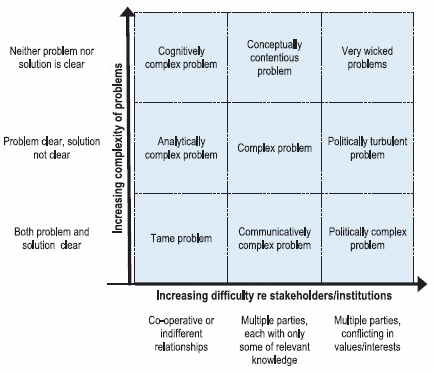
Focusing on two elements which they claim are irreducible does impede the ability to comprehend the intricacy and scale of a truly wicked problem. The challenge then becomes why only two elements and why are the elements irreducible? The second aspect related to nominated dimensions, abstraction of reality, subsequently leading to selection bias is why fixed dimensions?
Some thoughts will be given on the above questions raised:
- Why only two elements
- Why are elements irreducible
- Why fixed nominated dimensions
This raises the question, how would Alford & Head model tame problems, and could anything be learnt from that exercise? That will be done on this site after having a brief view of tame problems or the rational scientific methodology and subsequently apply any insights gained to modeling wicked problems.
Studying Wicked Problems Forty Years On
This is a study and analysis of more than one hundred articles on wicked problem to the purpose of where public administration research should focus. In the abstract to this paper lies what appears to be a key to a fundamental problem.
Over the years, the concept of ‘wicked problems’ has inspired a diverse set of contributions. However, the lack of a clear underlying definition makes it difficult to advance scholarly knowledge on ‘wicked problems’ in public administration research. (Danken, Dribbisch, & Lange, 2016)
It is public administration researchers not understanding lessons from tame problems which therefore opens a Pandora’s box trying to understand wicked problems! More on this later as tame problems will be looked at in a little detail.
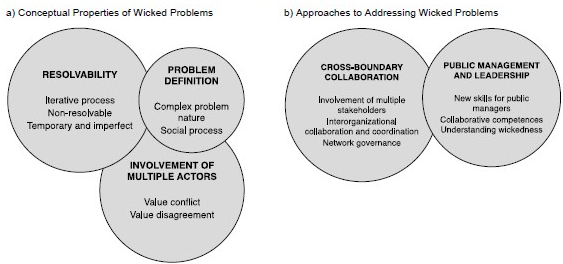
Nevertheless this paper’s findings cluster the traits of a wicked problem into three themes:
- Non-resolvable
- Multi-actor environments
- Problem definition
Under the question posed in the paper expanding on the three themes: What is the Problem With Wicked Problems? a number of dilemmas are highlighted in the description of the various articles:
- Researchers stating an iterative process is needed to resolve any issue which subsequently reveals new and unexpected problems
- Wicked problems defy any right answer where any resolution is along the lines of better-or-worse or good-enough
- Wicked problems tend to be chronic due to it involves a diverse set of stakeholders
- The stakeholders have different views and values with diverging interests and agendas (most likely hidden agendas!)
- Wicked problems are likely to be unique and not previously encountered
There is a distinct observation in that all these characteristics are somewhat inter-related in a convoluted way. They cannot be taken apart somehow and solved in a piecemeal fashion as one would an machine? The authors continue in Discussion and Conclusion:
Based on this finding, we argue that the common denominator of the scholarly understanding of wicked problems is that they are chronic public policy challenges that are value-laden and contested and that defy a full understanding and definition of their nature and implications. . . . It is parsimonious because we remove some of the concept’s definitional baggage by limiting it to three attributes only.
They also present approaches to addressing wicked problems as:
- Cross-Boundary Collaboration
- Public Management and Leadership
The above is succinctly captured in the authors own diagram repeated below.
This leaves open a question of a causality dilemma or commonly known as the which came first chicken or the egg on many levels!
As stated above tame problems will be looked at in more detail to get some ideas of how to describe, categorise or approach wicked problems. And as an extra an answer will be given to the problem which came first the chicken or egg.
References
- Alford, J., & Head, B. W. (2017). Wicked and less wicked problems: a typology and a contingency framework. Policy and Society, 36(3), 397-413.
- Auld, G., Bernstein, S., Cashore, B., & Levin, K. (2007). Playing it Forward: Path Dependency, Progressive Incrementalism, and the “Super Wicked” Problem of Global Climate Change.
- Danken, T., Dribbisch, K., & Lange, A. (2016). Studying Wicked Problems Forty Years On: Towards a Synthesis of a Fragmented Debate. dms – der moderne staat – Zeitschrift für Public Policy, Recht und Management, pp. 15-33.
- Global Extreme Poverty. (2019). Retrieved from Our World In Data: https://ourworldindata.org/extreme-poverty
- Lindberg, D. C. (1992). The Beginnings of Western Science: The European Scientific Tradition in Philosophical, Religious, and Institutional Context, 600 B.C. to A.D. 1450. The University of Chicago Press.
- Roberts, Nancy Charlotte. “Wicked Problems and Network Approaches to Resolution.” International Public Management Review 1.1 (2000): 1-19
- Turnbull, N., & Hoppe, R. (2019). Problematizing ‘wickedness’: a critique of the wicked problems concept, from philosophy to practice. Policy and Society, 38(2), 315-337

